
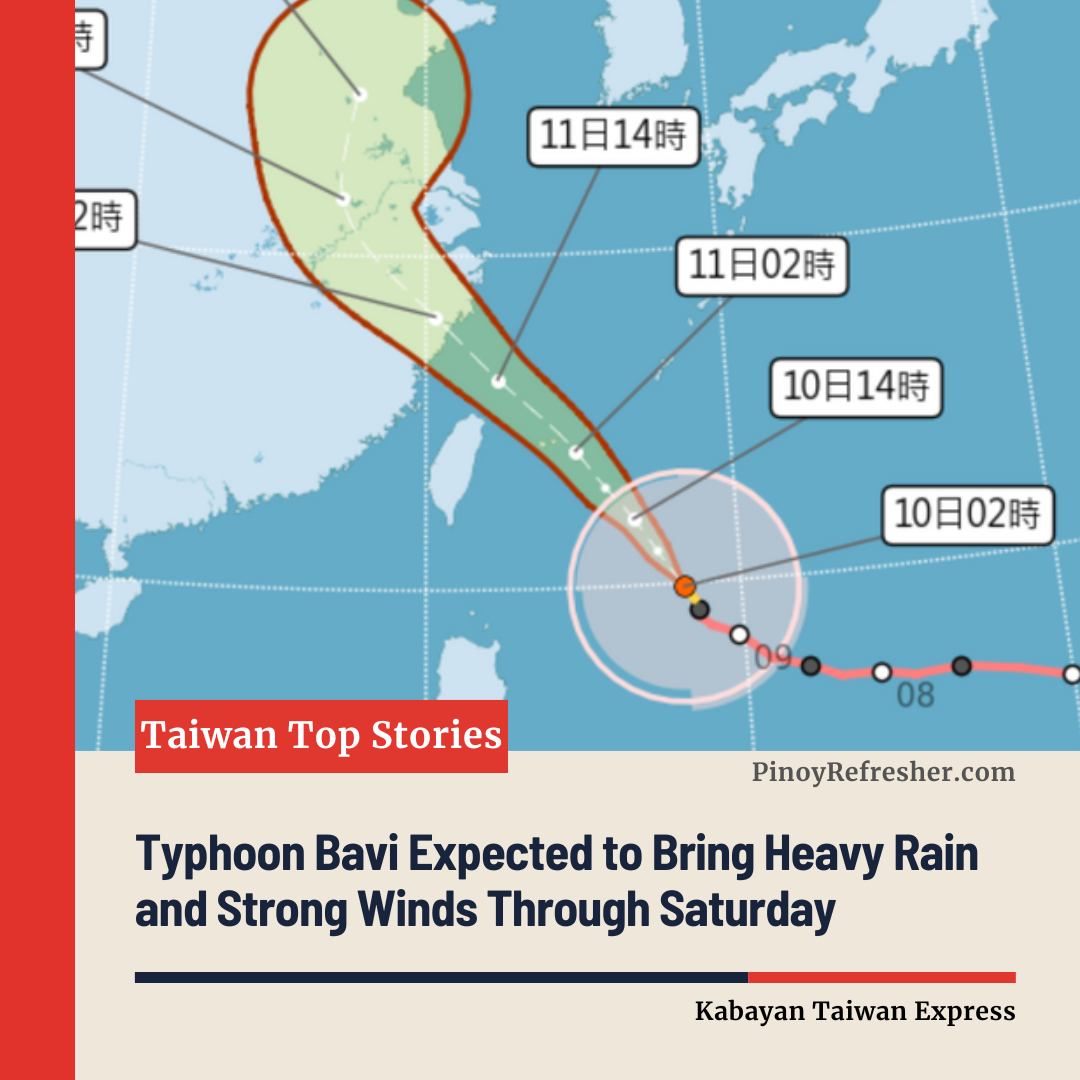
Typhoon Bavi Nears Taiwan as Land Warning Takes Effect; Heavy Rain and Strong Winds Expected Through Saturday
Taipei, Taiwan – July 10, 2026 — Taiwan’s Central Weather Administration (CWA) has warned that Typhoon Bavi is moving closer to the island, with its storm circulation gradually entering waters southeast of Taiwan. Authorities expect the typhoon to bring its most severe weather from Friday night through Saturday, prompting residents to complete preparations and remain alert.
The CWA issued a land typhoon warning at 5:30 a.m. Friday, with the initial warning covering New Taipei City, Yilan County, and Hualien County. A sea warning also remains in effect as the storm continues its approach.
As of 5:00 a.m., the center of Typhoon Bavi was located approximately 300 kilometers east of Taipei. The storm was packing maximum sustained winds of 45 meters per second, equivalent to Level 14 on Taiwan’s wind scale. Its storm-force wind radius measured about 380 kilometers, while hurricane-force winds extended roughly 180 kilometers from the center.
Heavy Rain and Strong Winds to Intensify
Weather officials said northern and northeastern Taiwan will experience intermittent rainfall during the morning, with conditions expected to deteriorate significantly later in the day as the typhoon draws nearer.
By Friday evening and continuing through Saturday, strong winds and widespread heavy rain are forecast across much of Taiwan. The greatest rainfall is expected in northern Taiwan, Yilan County, and mountainous areas in central Taiwan, where torrential rain is possible.
Other parts of the island can also expect scattered showers and thunderstorms, with southern Taiwan and the mountainous areas of Taitung facing the possibility of localized heavy rainfall.
Forecasters noted that Typhoon Bavi’s path may still change slightly, and residents are encouraged to monitor the latest official weather updates.
Hot Weather Continues Before the Storm
Despite the approaching typhoon, hot weather is expected to persist across Miaoli and areas farther south, as well as Hualien and Taitung, where daytime temperatures may reach 34°C to 35°C.
Temperatures could exceed 36°C in inland areas of central and southern Taiwan, mountain regions, the Huatung Valley, and Kinmen. The CWA also warned that foehn winds may develop in eastern Taiwan and Kinmen, increasing the risk of extreme heat. Residents are advised to stay hydrated, limit outdoor activities during peak heat, and protect themselves from sun exposure.
Meanwhile, northern Taiwan and Yilan are expected to be slightly cooler, with highs ranging between 31°C and 32°C due to increasing cloud cover and rainfall.
Dangerous Waves Along the Coast
The weather bureau also warned of dangerous long-period waves affecting the coastlines of northern Taiwan, eastern Taiwan, Orchid Island (Lanyu), Green Island, the Hengchun Peninsula, and the Matsu Islands.
Wave heights around Taiwan are expected to increase to more than 3 meters, while eastern coastal areas and the Hengchun Peninsula could experience waves exceeding 6 meters.
Authorities strongly advised the public to avoid beaches, coastal areas, and other waterfront locations during the storm.
Weather Outlook
The strongest impact from Typhoon Bavi is expected to continue through Saturday, with widespread heavy rain and powerful winds affecting much of Taiwan. Weather conditions are expected to gradually improve on Saturday night as the storm moves toward China.
On Sunday, although the typhoon is forecast to move farther away, unstable weather will remain. Western Taiwan and Taitung are expected to see scattered showers and thunderstorms, while other regions may still experience occasional rainfall.
Looking ahead to next week, forecasters expect moist conditions to persist, bringing afternoon thunderstorms to many parts of Taiwan, especially mountainous areas. Southern Taiwan, Hualien, Taitung, and the Hengchun Peninsula are likely to continue experiencing periodic rain showers.
Authorities are urging residents to stay informed through official weather advisories, complete typhoon preparedness measures, and avoid unnecessary travel while Typhoon Bavi affects Taiwan.